
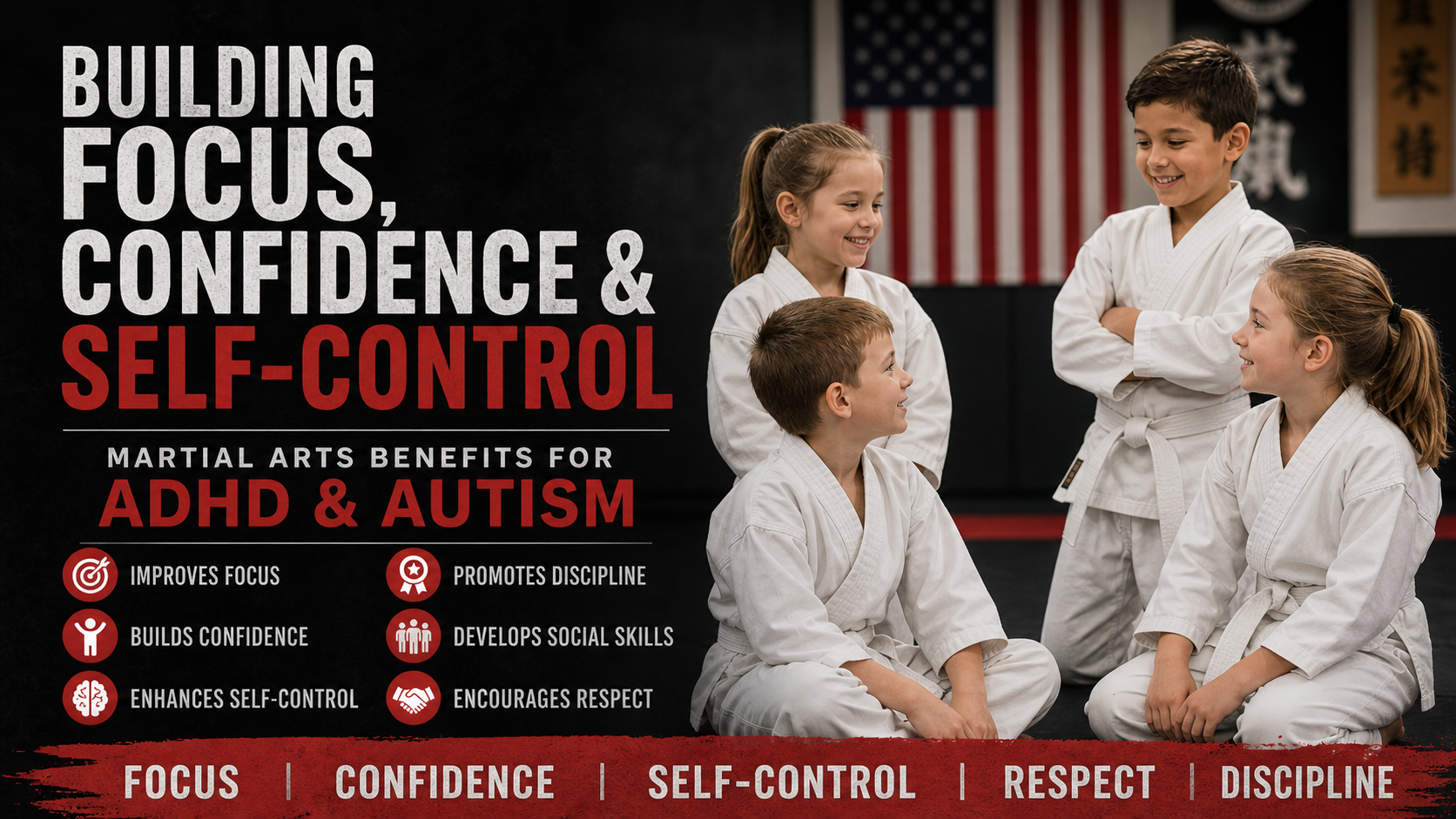
Martial Arts for Focus, Confidence, Discipline, and Personal Growth
At Stone Tiger Dojo Martial Arts Academy, Renshi Brad Rammel is the primary instructor and personally leads the training environment. This allows students and families to experience a consistent teaching style, clear expectations, and a steady relationship with the instructor.
Renshi Rammel believes martial arts can be especially beneficial for children, teens, and adults who may struggle with focus, confidence, self-control, social interaction, anxiety, coordination, or emotional regulation. While martial arts is not a medical treatment or replacement for professional care, structured martial arts training can provide a positive, disciplined, and encouraging environment where students learn practical life skills one class at a time.
This is especially meaningful for students with ADHD, students that are neurodivergent, and students who simply need a place where structure, patience, repetition, and encouragement are part of the learning process.
Benefits for Students with ADHD
Many students with ADHD benefit from structure, movement, repetition, and clear expectations. Martial arts training naturally combines all of these elements.
In class, students are asked to listen, watch, wait their turn, follow directions, control their body, and complete techniques in a specific order. Over time, this can help reinforce important skills such as:
Focus and attention
Self-discipline
Impulse control
Respect for others
Listening skills
Confidence
Goal setting
Emotional control
Physical coordination
Perseverance
For a student with ADHD, martial arts can provide a constructive outlet for energy while also teaching the importance of patience, control, and personal responsibility. The belt system also gives students visible goals to work toward, helping them experience progress in a way that is structured and rewarding.
The CDC identifies behavioral strategies, education, training, and healthy habits such as physical activity as important supports for individuals with ADHD, and CHADD also notes that exercise may help support attention, executive function, and behavior in some children.
Benefits for Students on the Autism Spectrum
Students on the autism spectrum may benefit from martial arts because classes are structured, predictable, and skill-based. Many students respond well to consistent routines, repeated practice, visual demonstration, and step-by-step instruction.
Martial arts can support development in areas such as:
Body awareness
Balance and coordination
Confidence in movement
Personal boundaries
Social interaction
Following multi-step directions
Respectful communication
Self-regulation
Confidence in group settings
The dojo environment can also help students practice social skills in a natural but structured way. Students bow, line up, take turns, work with partners, respond to instruction, and learn how to interact respectfully with classmates and instructors.
Research and autism-focused resources have reported that physical activity can support social participation, motor skills, coordination, attention, and confidence for some individuals on the autism spectrum. Autism Speaks specifically notes that physical activity can help with balance, body coordination, visual-motor control, and social development opportunities.
Why Martial Arts Can Be Different from Other Sports
Unlike many team sports, martial arts allows each student to progress at their own pace. Students are not judged by how many points they score or how they compare to others. Instead, progress is measured through effort, improvement, attitude, discipline, and consistency.
For students who may feel overwhelmed in large team environments, martial arts can offer a more individualized path. The class has structure, but the journey is personal. Every student has the opportunity to improve from where they begin.
Martial arts training also teaches students that success is earned through repetition. A technique may not be perfect the first time. A kata may take time to learn. A belt promotion may require patience. These lessons help students understand that struggle is part of growth.
A Family-Oriented Training Environment
Stone Tiger Dojo is built around family, respect, and community. The goal is not only to teach punches, kicks, blocks, self-defense, karate, or grappling. The deeper goal is to help students become stronger, more confident, more respectful, and more capable in everyday life.
Renshi Rammel understands that every student learns differently. Some students need more structure. Some need more patience. Some need encouragement. Some need help building confidence. Some need help learning how to control their energy, emotions, or reactions.
At Stone Tiger Dojo, students are taught with firmness, kindness, discipline, and respect.
Our Belief
We believe martial arts can help students grow in body, mind, and character.
We believe children can learn confidence without arrogance.
We believe discipline can be taught with encouragement.
We believe respect should be practiced inside and outside the dojo.
We believe students with ADHD, autism, anxiety, shyness, low confidence, or coordination challenges deserve a place where they can feel supported, challenged, and valued.
We believe martial arts can help students discover that they are capable of more than they thought possible.
At Stone Tiger Dojo Martial Arts Academy & Fitness Center, every student matters. Our mission is to help each student grow stronger, safer, more confident, and better prepared for life.